

Step back to nine in the morning on 4 December 2009.
Six patients are ready for surgery at three different hospitals across the UK.
It is the culmination of months of preparation and a remarkable event in the history of live organ donation in this country.
This is a three-way kidney swap between couples who've never met.
In Aberdeen, 54-year-old Andrea Mullen suffered sudden kidney failure three years ago.
It had a devastating impact on her life. She had to have dialysis three times a week.
She said: "It was just an existence, it really was.
"It was terrible being ill all the time. As far as I was concerned it just ruined my life. It just totally ruined my life and I hated it."
Her husband Andrew, 53, was prepared to donate one of his healthy kidneys but he wasn't a match.
Six hundred miles away in Hastings on the south coast of England, there was a similar story. Chris Brent, 42, also needed a transplant.
His sister, Lisa Burton, who is 45, was happy to give him one of her kidneys, but again there was no match.
And in St Albans in Hertfordshire, newly-wed Lynsey Thakrar, 30, wanted to donate one of her kidneys to her husband Teemir, but she too wasn't a compatible donor.
Precious gift
The solution - to pair up the couples - has only been possible since a change in the law in 2006.
Under strict supervision the Human Tissue Authority now allows so-called pooled transplant arrangements - matching up couples all over the country.
When Chris Brent heard about the change he was desperate to be involved. "I jumped at the chance to get a new kidney," he said.
Teemir felt the same. "Even though I knew I wouldn't be getting my wife's kidney, you're effectively going to be getting a kidney from somebody that is doing the same for their loved one. So it was just an amazing thing that could happen."
The surgery took place at two hospitals in London - Hammersmith and Guy's and St Thomas' - and the Royal Infirmary in Edinburgh.
It required enormous planning. Three kidneys removed from healthy patients, transported all over the UK and transplanted into the recipients on the same day.
Vassilios Papalois, consultant renal surgeon at Hammersmith, said: "The surgery was a success and I hope we can do more paired and pooled transplants. In the US they are already doing up to 12 pairs at once - so that's something to aspire to."
The result of the surgery has been dramatic. Three months on all six patients are doing well.
Quality of life
In Hastings, Chris Brent, who had seven years on dialysis, lost his job and became depressed, says the transplant has given him a chance for a new start in life.
"Literally as you wake up out of the anaesthetic you feel better," he said.
"I just want to live a fairly normal life again. Go back to work, get out and about more. Have a life rather than just existing."
In Aberdeen, Andrea and Andrew are planning their first holiday in years.
"I feel like I've got my life back," said Andrea. "I've got more energy. I'm eating better and it's great."
And in St Albans, Teemir and Lynsey, who were married last year, say they are now ready to start a family.
"Now that I'm off dialysis," says Teemir, "the future is a normal family life. In time we hope to have children. It's something we couldn't contemplate this time last year."
As for the donors, they all say they are proud to have given up one of their kidneys - even if they have ended up in strangers they've never met.
"I'm absolutely delighted that Chris can have a normal life now," says his sister Lisa, "and all the other people can as well. It's a threefold thing really so it's a real good feelgood factor all round."
Complex
"It is a little odd," says Lynsey. "But in the end it wasn't that I didn't give any thought to donating my kidney. It was that I didn't need to give it any thought. He's the man I love. He's the man I want to spend every day of my life with. I want him healthy and if it means giving my kidney to a stranger so be it."
Vicki Chapman, director of policy and strategy at the Human Tissue Authority, said: "These are the first transplants of their kind to happen in the UK. The HTA has to pay particular attention to these types of donation as the issues are particularly complex when more people and more centres are involved."
There are 7,000 patients currently on the waiting list for a kidney transplant in the UK.
One in three kidneys used in transplants now comes from a living donor.
Your request is being processed... Lisa Hofstra Settles With City For $78K: Nurse Handcuffed By Cop For Not Drawing Blood On Command
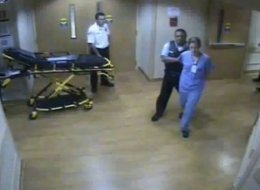
A nurse who was handcuffed by a Chicago Police Officer when she refused to draw blood from a drunk-driving suspect fast enough for him in August settled her lawsuit against the officer for $78,000.
The Chicago Sun-Times reports that Lisa Hofstra, a nurse at Advocate Illinois Masonic Medical Center, sued Officer Marcelo Rodriguez and the city after Rodriguez allegedly became "belligerent" when she told him the hospital could not draw blood until the driver was admitted as a patient.
Rodriguez then handcuffed Hofstra and forced her to sit in the back of a squad car for 45 minutes, the Sun-Times reports.
"He snucked up behind me grabbed my arms," Hofstra told ABC Chicago in September. "I didn't even realize what was happening...I just saw the faces of the people in front of me before I realized I was in handcuffs."
"Literally he held her hostage until there was a blood test done," Hofstra's attorney Blake Horwitz, told ABC.
Horwitz told the Sun-Times Tuesday that Hofstra understands the need for officers to obtain blood samples, but "it just has to be done through proper means."
The blood samples the officer wanted involved a drunk driving case that goes back to court March 10. The Sun-Times reports:
The driver, Raquel Wright, 47, was arrested for allegedly striking 24-year-old motorcyclist Alexandru Foamete with her Volvo at 3:05 a.m. Aug. 1 at Ashland and Wilson on the North Side. She failed a field sobriety test and refused further tests, police said. Foamete died Aug. 7. Wright has been charged with reckless homicide and aggravated DUI.
Exodus of health workers paves way for bilateral pacts
Seeing no end to the outmigration of Filipino nurses and doctors, a former health secretary has taken steps to “tame the exodus” and achieve a win-win situation for both the Philippines and foreign countries employing our medical professionals.
For a number of years now, Dr. Jaime Galvez-Tan, former Department of Health (DoH) Secretary, has been working for partnerships among countries recruiting Filipino nurses and doctors.
Tan, who initiated an extensive study on the exodus of medical professionals and its effects in the Philippine healthcare system, has formulated ways to improve the situation by seeking bilateral agreements with receiving countries such as Canada, Finland and Australia, among others.
“I have accepted globalization and I have accepted that Filipino nurses are bound to go. Let us tame the exodus; you cannot stop them; that is their human right. Let us tame it,” said Tan, an educator at the University of the Philippines (UP) College of Medicine and founder of Health Futures Foundation, Inc., which trains community health workers nationwide.
Though lacking official government backing, Tan was able to secure on-going negotiations from recruiting countries such as Finland, Canada, Australia and Bahrain to establish a trust fund for health human resources development.
“We can turn migration into a positive force rather than a negative force.”
The proposed RP-Partner trust foundation seeks the adoption of a Philippine region such as Iloilo, Surigao, Agusan del Norte and Agusan del Sur with the recruiter pouring direct investments in its health system.
Tan is also negotiating for employed nurses to return to the Philippines after two years of service abroad to share their knowledge among Filipino nurses for a period of six months. “I call this brain circulation,” he said.
For nurses who may opt to stay and teach in the Philippines, Tan has asked recruiting countries to provide a Masters Degree scholarship to be provided by the state or the hospital where the nurse is employed.
Other negotiations in the “win-win” bilateral agreement include the provision of three nursing scholarships in a Philippine nursing school partner for every Filipino nurse recruited by the state or the hospital and the improvement of a healthcare facility for every 10 nurses recruited.
For 20 nurses recruited, a nursing school should be improved and for 50 recruited Filipino nurses, Tan seeks for the improvement of a training hospital.
Tan’s research shows the Philippines remains the top exporter of nurses to the world and the number two exporter of doctors, following India.


